Making it all work

You can see by just one glance at our plans for this school year that there’s quite a bit of creative scheduling required to make it all work (either that or I’d need to add about 10 hours to each of our days).  I really wasn’t sure how it was going to work, but it is working and quite well!  I thought you might like a glimpse of how all of this looks in our day…

(by the way, I’m sorry I can’t share this in PDF files…that has me stumped and I had to choose to either figure out Adobe or sleep…I chose the latter)

First, I needed a plan for each of the boys.  A plan that they could each pick up and get going.  Enter The Daily Grind…a checklist adapted to each individual…work they are expected to do independently is in black; work they are expected to do with my help is in purple.  They may complete their independent work in any order they choose and they know that once that is all checked off, they are free to take a break.  Everything in the checklist must be complete by the end of the day.  I sometimes pencil in major topics or books I don’t want to forget or narration topics at the beginning of the week and after their lessons are through, I might jot down some notes (such as lesson # or topic covered) just for my own future reference.  Gone are the tedious days of planning out each individual subject.  Instead, we pick up where we left off.  So if we did lesson 8 in math today, tomorrow will be lesson 9.  The glory of planning this way is that if we need 2 days to complete lesson 8 (maybe it’s taking longer than expected or maybe it’s just not sinking in the first time through), we can easily adapt to that without feeling like we need to double up on lessons or without the added anxiety of falling behind.

2014-09-01_1527

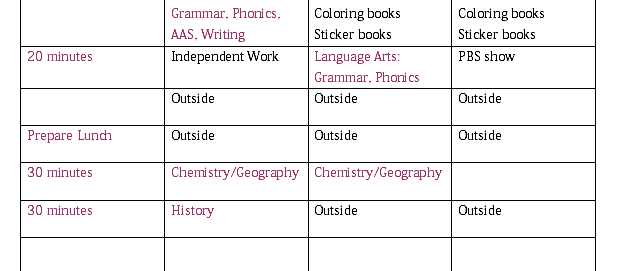
2014-09-01_1535So this was a good start, but I needed more…how was I going to manage the other two boys while working individually with each one?  Here was my solution (By the way: 1. These times are totally approximate. I wanted to leave room in the margin…so far we’ve been finishing up each of our days before noon.  2.  You can’t see the whole thing in one shot…I’m using Jing here and I can only capture so much, so that’s why it’s broken into 2 images.  3.  The things marked in blue are things that the boys are expected to either do together.)

2014-09-01_1540

2014-09-01_1543

You’re probably wondering what “Together Time” consists of…I needed a bit more detail there, as well.  I pencil in major books or topics to be discussed at the beginning of each week.  So here’s how our time together breaks down…

2014-09-01_1544

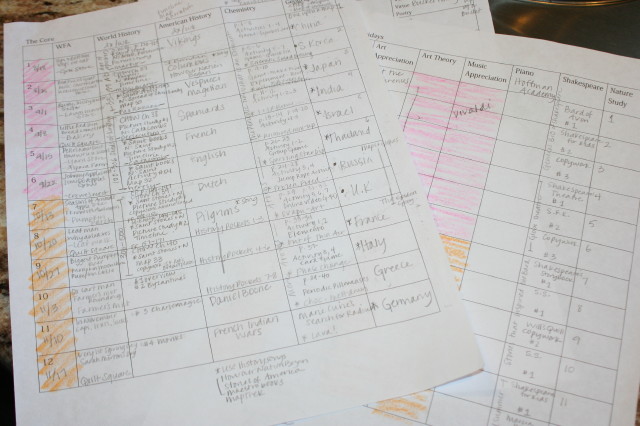
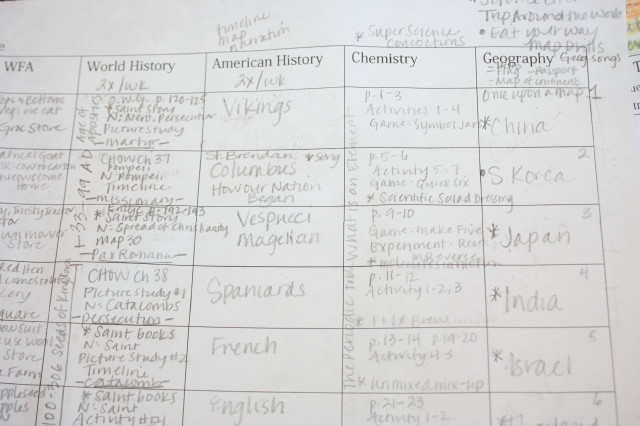
I know I mentioned that for the most part, our plans simply consist of following along in the book.  Some subjects needed a little more planning (like if I am not using a specified curriculum or combining more than one curriculum).  I’m a pencil and paper kind of gal, so my planning for that isn’t fancy, nor is it very legible for the rest of the world, but I’m going to include a snapshot of it here ( I apologize that it’s not easily readable!).  I plan in 12 week chunks (that way I only have to do major planning 3 times throughout the year) and I simply highlight subjects to be covered, books to be used and any major activities or projects to be completed.

sept 1, 2014 016_1 sept 1, 2014 017_1


I’d love to see how you are planning…feel free to leave a link in a comment!


2014-2015 Plans

sept 1, 2014 004_1

We’ve got such an exciting year ahead…from chemistry to medieval history to eating around the world (yet again)!  Here I share all of our plans!

For Joseph, William & Andrew: Our Morning Time:

For our literature studies, we’re following Wee Folk Art’s plans loosely, focusing on lots of reading, crafts, and field trips plus quilt block making (we’re using Hand Print Quilts, though, instead of Wee Folk Art’s recommendation of batiking).

Faith: A lesson each day from Living in God’s Law plus reading (some of our selected books for the year include Angel Food, Leading the Little Ones to Mary, Chats with God’s Little Ones, Growing Up with a Bucket Full of Happiness, St. Patrick’s Summer, The Mass Explained to Children, Treasure Box books); also, at some point we’ll add back in our Catholic Mosaic reading and our Catechesis of the Good Shepherd.

sept 1, 2014 006_1

Songs & Fingerplays: The Complete Book of Songs, Rhymes & Fingerplays alternated with Mother Goose and enhanced with our good ol’ felt board

Memory Work: We’re not using a specific program, but we’re covering Math (using Addition and Subtraction Songs); Science (elements of the periodic table); Grammar (questions from Living Memory, lists as we cover them in grammar); Great Words (poetry and bible verse selections); Spanish and Latin (vocabulary from previous week’s lessons); History and Timeline (using Classical Conversations History sentences and Timeline song); Shakespeare (using Ken Ludwig’s How to Teach Your Children Shakespeare)

sept 1, 2014 009_1

Spanish: Teach Them Spanish

Virtue: Laying Down the Rails for Children

Geography: Once Upon a Map; Maps & Globes; The Golden Geography

Poetry: Favorite Poems Old and New

Joseph and William:

Science: Chemistry using Elements: The Ingredients of the Universe along with Super Science Concoctions and Fizz, Bubble & Flash

World History: Beginning with the year 33 AD, using RC History until 500 AD and then switching over to Pandia Press‘ History Odyssey (will definitely still be using selections from RC History’s booklists)

sept 1, 2014 002_1

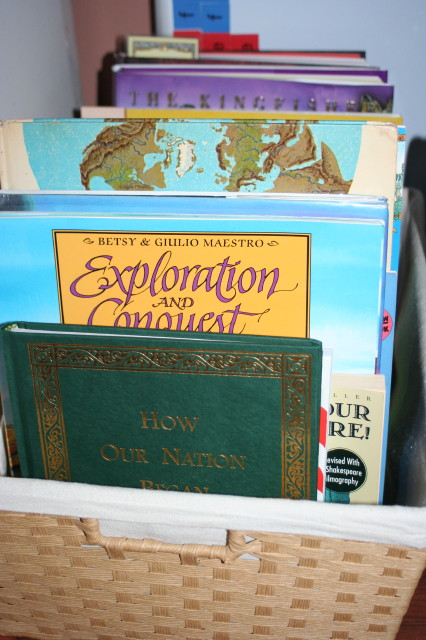
American History:  RC History and Serendipity‘s book lists; Betsy Maestro’s books, Stories of America and How Our Nation Began as our spines

Geography: parts of Expedition Earth; The Science Chef Travels Around the World; Eat Your Way Around the World; map drills

Math Fact Practice: Xtra Math

sept 1, 2014 007_1

Fine Art Fridays:

Piano: Lessons from Hoffman Academy

Music Appreciation: Classical Kids

Art: Home Art Studio and See the Light DVDs

Art Appreciation: Spot the Differences, Memoria Press’ art cards, Usborne’s My First Art Coloring Book

Shakespeare: Plans from Serendipity

Nature Study: Simply Charlotte Mason’s The Outdoor Secrets

Joseph:

Math: Saxon 2

Grammar: First Language Lessons Level 3

Spelling: All About Spelling (picking up with Level 5)

Phonics: Little Angel C & D

Critical Thinking: Mind Benders

Latin: Prima Latina

Map Skills

Handwriting: New American Cursive II

Typing: Mavis Beacon

William:

Math: Saxon 1, Hands-On Thinking

Grammar: First Language Lessons Level 1

Spelling: All About Spelling Level 1

Critical Thinking: Mind Benders

Handwriting: Handwriting without Tears K

Map Skills

Phonics: Little Angel A & B

Andrew:

Math: Saxon K

Grammar: Language Lessons for Little Ones

Critical Thinking: Building Thinking Skills

Phonics: Learning/reviewing letter sounds; when he’s ready we’ll start All About Reading Level 1

sept 1, 2014 001_1

If you want to see how it all works and fits into our daily schedule, that’s next…

For the Mom who’s just starting out on the homeschooling track…

The question I get asked most often is, “What should I do to get started homeschooling?”  My answer is simple.  Read.  Educate yourself.

The idea of homeschooling can be overwhelming.  Many of us feel called to do it, but most of us feel overwhelmed by the enormity of the task.  We fear the whole idea of being solely responsible for our children’s education.  Fear is good.  It motivates us to learn.  And so if you’re thinking about homeschooling or just beginning along the path, I implore you to educate yourself.

The following are books, audio recordings and websites that I have read and found helpful in my journey.  This list is not exhaustive…there are so many other gems that I have stumbled upon over the years.  But these listed here are my tried and true resources…the ones I refer to time and again.  I DID NOT read them all before beginning to homeschool…these are books and recommendations to guide you and lead you as you journey.  This list does not offer support for specific subjects you’ll be teaching (you can find wisdom and insight at the 4real forums or the WellTrainedMind forums) or for curriculum providers (of which I have many favorites, including Serendipity’s Alphabet Path, Heart of Dakota, Memoria Press, Sonlight, WinterPromise).  The books that are marked with a * are Catholic resources.  My point is not to overwhelm you with resources, but rather to give you a variety to choose from.

August 21-August 24, 2014 010_1

Here are some excellent resources to read to strengthen your resolve (just in case you’re worried that the “experts” know how to educate your children better):

For the Children’s Sake by Susan Schaeffer Macaulay

Educating the Whole Hearted Child by Sally and Clay Clarkson

Reaching Your Child’s Heart by Sonya Shafer (an audio recording)

The Long Haul by Cindy Rollins (an audio recording)

Matt Walsh’s blog (you might want to start here!)

Freedomship & Entrepreneurial Education by Andrew Pudewa (a DVD)

Some basics about homeschooling (methods and general how to’s):

Teaching in Your Tiara by Rebecca Frech (I hesitate to recommend this only because I haven’t actually read it, but I have heard excellent things about it!)

Homeschooling Methods by Gena Suarez

*Love2learn‘s website

Now if you’re committed to homeschooling and you need to figure out how to do it, here are the resources I would recommend:

Charlotte Mason:

Charlotte Mason’s Original Works (these are rather meaty, so you may want to start with something a little lighter like the other recommendations listed here!)

A Charlotte Mason Companion by Karen Andreola

A Charlotte Mason Education by Catherine Levison

*Real Learning by Elizabeth Foss

Simply Charlotte Mason’s website and Sonya Shafer’s DVDs

Ambleside Online

*Mater Amabilis

Charlotte Mason Help

Classical:

The Well Trained Mind by Susan Wise Bauer

The Three R’s by Ruth Beechick

*Designing Your Own Classical Curriculum by Laura Berquist

Montessori (for the preschool years):

Mommy, Teach Me and Mommy, Teach Me to Read by Barbara Curtis

Teaching Montessori in the Home by Elizabeth Hainstock

Encouragement for the days when you need it (because you will need it!):

Teaching from Rest by Sarah Mackenzie (be sure to get the audio downloads…they are totally worth it!)

*Catholic Homeschool Companion by Maureen Whitman

For support in going against the grain (or in other words, battling cultural deficiencies):

Last Child in the Woods by Richard Louv or listen to Andrew Pudewa’s recording

A Landscape with Dragons by Michael O’Brien

Ten Ways to Destroy the Imagination of Your Child by Anthony Esolen

General Parenting Books that will help you in your homeschooling journey:

The Temperament God Gave Your Kids by Art Bennett

The Five Love Languages of Children by Gary Chapman

*Parenting with Grace by Gregory Popcak

*How to Raise Good Catholic Children by Mary Reed Newland

A Mother’s Rule of Life by Holly Pierlot

August 21-August 24, 2014 014_1

For those of you who like to listen to learn, check out the following:

Simply Charlotte Mason’s Sonya Shafer’s recordings

Institute for Excellence in Writing’s Andrew Pudewa’s recordings (all of his are awesome, but I would strongly suggest you begin by listening to Teaching Boys & Other Children Who Would Rather Make Forts All Day)

For you homeschooling mamas out there that are reading this, please feel free to leave a comment with any other resources that have been your inspiration or encouragement to you as you have journeyed.

2013 – 2014 Plan

I was just cleaning up my blog “dashboard” and stumbled on this old post that I apparently never posted!  So I am extremely late adding this, but I still wanted to include it (so I can look back some day and say, oh yeah, so that’s what we did…you know one day in the future when all of these years are a hazy fog!)…so here is what we did for 2013-2014 (I apologize that not everything is linked…could be why it never got posted!)…

Joseph and William and sometimes Andrew:

Faith: Catholic Mosaic books and copywork; Catechesis of the Good Shepherd (in our home with Moira Farrell’s handbook);

(Science and History: We are following the recommendations from The Well Trained Mind, with an emphasis on living books and narrations; since this was our first year formally studying history, I also used RC History’s Syllabus and Lesson plans)

Science: Biology (including animals, human body, and plants)

World History:  Ancient History following RC History plans and supplementing with The Story of the World

American History: Beautiful Feet

Memory Work: Classically Catholic Memory

Art: Picture Study (covering 1 artist every 6 weeks);  Artistic Pursuits Book 1 (K – 3)

Music: Composer Study (covering 1 composer every 6 weeks); recorder lessons

Geography: A Child’s Geography of the World by V.M. Hillyer, supplementing with Children Just Like Me, What the World Eats, Material World and Stories from Around the World.  Map Drills depending on which continent we’re studying (using Uncle Josh’s Outline Maps and Sonya Shafer’s method) and Joseph’s favorite part of Geography: Eat Around the World

Spanish: Puertas Abiertas; Fun Spanish; Whistlefritz and Little Pim DVDs; Salsa episodes; Spanish beginning readers; Spanish CDs

Joseph:

Math: Singapore 1A and 1B; Miquon Red Book

Handwriting: Memoria Press New American Cursive II

Latin: Prima Latina

Spelling: All About Spelling

Language: First Language Lessons Level 2

William:

Memoria Press Jr. K: filled with read alouds and crafts, poetry and recitation (Andrew follows along with most of this and Joseph can’t help but join in!); we replaced the two workbooks with Rod & Staff’s Do It Carefully and Numbers and Counting

Math: Singapore Level 1A (1st half of the year); Miquon Orange Book (2nd half of the year)

Handwriting: Handwriting without Tears Pre-K

Phonics:  All About Reading Level 2

Language: Language Lessons for Little Ones 2

Logic: Building Thinking Skills

Andrew:

Little Hands to Heaven and Catholic Icing

Summer Plans 2014

july 2, 2007 048_1We don’t stop schooling during the summer, but we do school a little differently. a little lighter, and a little more learner led.  We always keep up with math and reading, but the rest of our “school day” is led by the children’s interests.  This summer we’ll be spending our days studying plants and we’re shaking up our math and grammar quite a bit with some fun living book studies.  We’re also continuing along with American and World History and for the little ones, we’re adding Wee Folk Art’s summer plans into our days.

**I have to apologize that I don’t have all the links for the books done…maybe I’ll eventually get around to it, but I wanted to at least post the plans.

Wee Folk Art

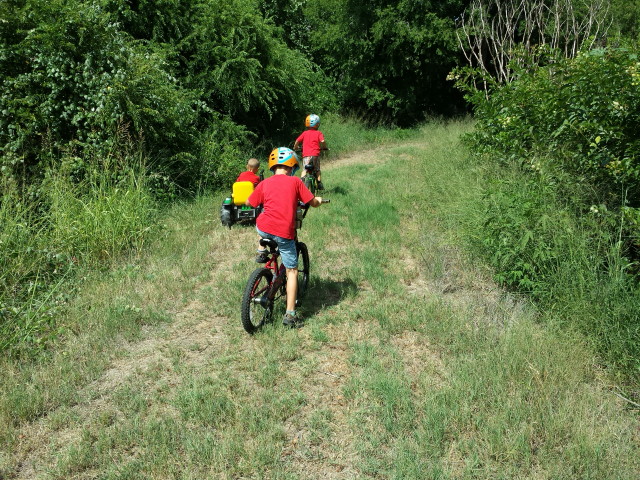
We’re using Wee Folk Art’s summer plans which include studying ponds and weather.  We switched the weeks around, so we started by studying ponds (for four weeks) and for the remaining 5 weeks, we’ll be studying weather.  Our Wee Folk Art plans basically consist of read-alouds, a poem to memorize, art and music appreciation, and a science experiment.  Plus 2 quilt blocks!  In the plans are a  few pond visits (including the one by Granny’s when we go to visit!) to see pond life (the pictures below are a recent trip out to Pollywog Pond).  Here are the books we used for ponds:  Frogs; It’s Mine; Box Turtle at Long Creek; Look out for Turtles; Little Wood Duck; Make Way for Ducklings; Have You Seen my Duckling?; Were You a Wild Duck; Ducks Don’t Get Wet; Pond Circle; Eliza and the Dragonfly; In the Small, Small Pond; Turtle Splash: Countdown at the Pond; Near One Cattail.  For the quilt blocks, we’re going to be doing handprint blocks, based on the ideas from Marcia Layton’s book Handprint Quilts.  Our pond quilt block will be ducks.
july 4, 2014 009_1 july 4, 2014 019_1 july 4, 2014 226_1

Beginning next week, we’ll be studying weather.  Our book list includes: Bringing the Rain to Kapiti Plain; Oh Say Can You Say What’s the Weather Today; Alfie Weather; Come on Rain; Little Cloud; The Cloud Book; Rabbits and Raindrops; Down Comes the Rain; Thunder Cake; Flash, Crash, Rumble and Roar; Rainbow of My Own; All the Colors of the Rainbow.  Our quilt block will be rainy days.

Plants

july 2, 2007 047_1

I gave the kids a choice for science this summer…plants or oceans.  Surprisingly (or not, since what boy doesn’t love dirt?), they chose plants.

july 2, 2007 060_1

The main topics we’re covering are flowers, seeds, leaves, stems and roots.  We’re using AIMS Primarily Plants for hands-on experiments and tending our own garden.  And, of course, we’re armed with an exciting book list.

july 1, 2007 041_1

Here are our plant books for the summer: The Reason for a Flower; How Flowers Grow; Pick, Pull, Snap; How a Seed Grows; Planting a Rainbow; Sunflower House; From Seed to Plant; The Complete Book of Flower Fairies; Fairy Houses…Everywhere; How to Find Fairy Houses; Fairy Houses of the Maine Coast; In a Nutshell; One Bean; A Tiny Seed; The Dandelion Seed; A Seed is a Suitcase; A Seed is a Promise; DK Eye Know Plants; Peter in Blueberry Land; Growing Vegetable Soup; Going on a Leaf Hunt; Weeds and Wildflowers; Jack’s Garden; To Be Like the Sun; Up, Down, Around; What Do Roots Do.

july 1, 2007 030_1

Before we started our plant unit, I was reading a series of books by GJ Walker Smith.  In her books, she tells these fascinating stories about fairies (some of which she made up and some based on legend).  I got really excited about fairies, but figured the boys would totally not be interested.  I should have realized that at the mere mention of building (fairy houses, of course!) they would be on-board.  Joseph, especially, got very excited, taking on the role of the Leaf Fairy (we all get sprinkled by leaves when he passes by us!).  The boys spent this past week building fairy houses (and they followed all of the rules, as outlined in the Fairy House books.  Our Fairy Houses of the Maine Coast book is missing in the picture above because it spent much of its time outdoors this week, providing inspiration and guidelines.
july 1, 2007 001_1 july 2, 2007 042_1

Our plant unit also happened to correspond with my book club book The Language of Flowers by Vanessa Diffenbaugh.  Fascinated by the idea that flowers speak a language and mystified by the process of buying flowers, I enlisted the help of the kids to tackle the world of flowers.  First we visited a local florist who was kind enough to teach us everything we wanted to know about what it’s like to be a florist.  The kids loved standing in the walk-in refrigerator and each one brought home a flower of their choosing.  Our friendly florist explained that by putting flowers in a vase beside your bed you are guaranteed to have sweet dreams.  Both William and Joseph were pleased to include this new idea as part of their bedtime routine.  I showed Joseph the guide at the back of The Language of the Flowers and just like me, he fell in love with the idea that flowers can speak.  He looked up each of our flowers from the florist shop and gasped when he realized the flower of his choosing, the red carnation, meant “my heart breaks.”  Before I knew it, he had drawn a bouquet for me based on the meaning of the flowers (apparently, when you are 7 or younger, a flower is a flower is a flower because they simply drew whatever flower they imagined in their drawings and then simply labeled them…it never occurred to them that each flower looks different). My bouquet included flowers that meant beloved daughter, love and sweet and lovely.

july 1, 2007 037_1

Then William and Joseph appeared with another hand-drawn bouquet…this one filled with flowers that did not carry such a loving message.  The flowers in this bouquet meant things like I cannot be with you, I do not trust you and, even, I declare war on you.  A little shocked at the message, I said, “Oh wow, this bouquet seems a little angry.”  “Well, of course! We drew this bouquet for the devil!”  A bouquet for the devil…who could have imagined such a thing!

july 1, 2007 038_1

When our initial fresh flowers began to wither, the boys each chose a flower to press and then they kindly requested another trip to the florist.  We visited a different florist (the one who did mine and Daxson’s wedding flowers 11 years ago!) and armed with the guide, each child was able to pick out a flower that had a particular meaning.  (William insisted on a red carnation.  I reminded him, “William a red carnation means ‘my heart breaks'”  “Yes, Mommy,” he solemnly replied, “I know.”  Hmm, not quite sure what to make of that.)  Andrew chose a lily, which means “message” and Joseph ended up with a Chrysanthemum, which means “truth”.  All the boys were quite pleased with their choices and the flowers are still sitting beside their beds, bringing them sweet dreams.

july 1, 2007 035_1

History

We are continuing our study of World History, mostly covering the beginning of Christianity.  We’re finishing up Story of the World Volume 1 alongside our RC History lesson plans (the beginning of Volume 2).  For American History, we are following Serendipity’s Native American plans, making an ABC Native American book based on D is for Drum and we’re learning quite a bit with the If You Lived With…books.  After our Native American study, we’ll review the early colonists.

july 1, 2007 036_1

Grammar

We are using Ruth Heller’s books and Word Fun for our grammar lessons this summer.  One day each week we’re reading a different Ruth Heller book (nouns, verbs, adjectives, adverbs, prepositions, interjections and conjunctions, pronouns) and then later in the week, we’re reading the corresponding section from Word Fun.  The Ruth Heller books are awesome…packed full of tons of information and so fun to read.  After reading the stories, the boys are making a page of that part of speech to add to their lesson book.  Toward the end we’ll be using Punctuation Celebration and Eats, Shoots,&  Leaves for a quick review of punctuation.

july 1, 2007 033_1

Math

For our math lessons this summer, we ‘re reading lots of math stories (especially Stuart J. Murphy’s books), playing games (using Family Math) and reviewing math facts (with flashcards and Xtra Math).

july 1, 2007 042_1 july 1, 2007 031_1


Our Schoolroom

school room 014_1

Our little schoolroom.  We spend quite a bit of our day in this room.  It’s filled with books and games and art supplies to fuel little boys’ imaginations.

school room 025_1 school room 026_1

After breakfast, we all head to the schoolroom.  We gather together to sing and pray. We begin our day with the Pledge of Allegiance and our calendar work.

school room 004_1

Then the big boys settle down with their work, while Andrew wanders over to his shelf and chooses an activity.  Katie roams around.

Andrew's shelf is the top shelf here...

Andrew’s shelf is the middle shelf here, filled with hands-on activities to keep a busy 2 year old, well, busy…

school room 024_1

This basket sits close to Andrew’s shelf. It is filled with the Bambino Luk and books.

We have a lot of school “stuff” so organization is a huge task.

The big boys each have a basket of their school books.

The big boys each have a basket of their school books.  This makes it easy for them to grab their work and get busy.  The big basket on the far right holds my books…lesson plans, teacher editions, and the like.  The boys’ school notebooks are nestled between their baskets.  Any narrations or worksheets are filed in appropriate notebooks at the end of each week.

school room 003_1

Our living books are kept here…bibles, history, geography and science books.  The basket on the right (with the upside down book!) houses all the books Joseph and William create.  The pencil boxes are the boys’ “school boxes” which hold their crayons, pencils, scissors and erasers.

school room 010_1

The closet…filled with games, manipulatives, art supplies, and more.

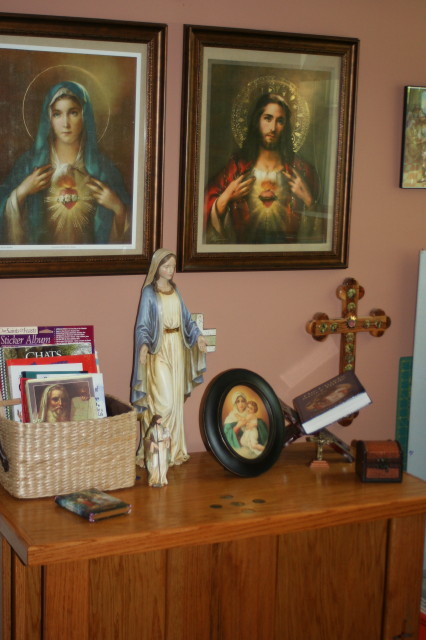
Here is our prayer corner, which doubles as our altar for our home atrium.

school room 007_1

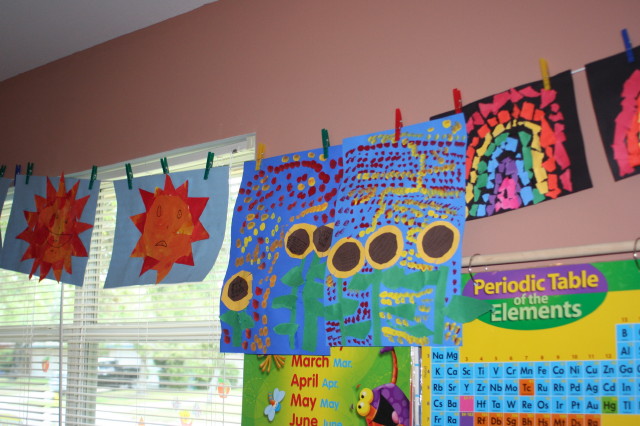
The boys love to showcase their work here (usually it’s school related work, but we’ve been painting A LOT with all this cold weather)…

school room 009_1

Our schoolroom isn’t just for school, though.  Joseph and William often disappear into this room as they create stories and books and games of their own.  Their imaginations come alive with the help of some colored paper, markers and tape.

school room 020_1

We have a magnetic chalkboard and whiteboard. The easel paper above the chalkboard can be pulled down and held in place with magnets for painting or drawing.  The IKEA buckets hanging above and below are awesome for storing chalk, erasers, markers and magnets.

m, n, o. p weeks 029_1

The paper organizer is filled with all sorts of paper (letter writing, blank, colored, handwriting), blank books, cards, and envelopes.

m, n, o. p weeks 030_1school room 018_1
It’s colorful.  It’s educational.  It’s inviting.  We love our time here.

Summer Plans

June 16, 2013 057_1_1

We don’t stop schooling during the summer, but we do school a little differently. a little lighter, and a little more learner led.  We keep up with math and phonics (reading or spelling, depending on whose lessons we’re referring to), but the rest of our “school day” is led by the children’s interests.  This summer we’re spending our days studying the presidents and birds, both topics chosen by Joseph and happily followed by William.  Here’s a basic overview of our plans:

Presidents:

Each day we’re studying a new president.  After reading all about the president of the day, Joseph makes a timeline page to add to his President Book.  Here’s what we’re including on each page:  The President’s Name; Years in Office; Vice President; # President; 5 Facts; President’s Nickname; Birthplace; Born and Died Dates; First Lady; a star sticker to symbolize the president’s party (gold for federalist, silver for democratic-republican, blue for democrat, red for republican, green for whig); a sticker portrait of the president; and a quote from that President.  Some days we complete just one, other days we complete more.  All last week, Joseph was up by 6:30 am (he who usually sleeps til 8!) to work on his President page.  After all the pages are complete, we’ll laminate them and have them bound into an official book.

June 16, 2013 056_1_1

The books we’re using for our research include the following:  So You Want to Be President; Don’t Know Much About the Presidents; The Scholastic Encyclopedia of the Presidents and Their Times;  DK Eyewitness Presidents; Wit and Wisdom (for the quotes); The Look It Up Book of Presidents

June 16, 2013 049_1_1

June 16, 2013 050_1_1

Some of the other things we’re supplementing our Presidential studies with include: Melissa and Doug President puzzle; The History Channel’s Presidents; Men of Destiny board game; Jingo American Presidents and First Ladies game; Meet the Presidents board game; Mr. President (and old time radio show); Sing a Song of Presidents (book and CD); President Activity book; Presidential Cookies (as soon as I’m back to baking, we’ll add a cookie recipe each week to supplement our studies); Dover President coloring book; Dover First Ladies coloring book

June 16, 2013 051_1_1

Birds:

For our bird study, we’re spending a lot of time outdoors with our binoculars looking for birds and learning to recognize them.  To do that, we’re using a Bird Log; Backyard Birding for Kids; and our Birds of Texas Field Guide.

June 16, 2013 055_1_1

Here are the extra resources we’re using for studying birds: Fifty Favorite Birds Coloring book; Birds Alphabet Coloring book; Bird Mazes; Learning About Birds; Your Backyard DVD (this is what sparked their interest and got us started on this unit study!); Crinkleroot’s Guide to Knowing the Birds; Crinkleroot’s 25 Birds Every Child Should Know;  The Bird Alphabet Book; Baby Birds and What They Eat; Reading Rainbow’s DVD: Birds of a Feather; Blues Go Birding; Tea with Lady Sapphire; Adventures of Sammy Jay; rubbing plates of birds; Bird Toob; Common Bird Songs; Bird Fun board game; Bird Watching Trivia board game

June 16, 2013 052_1_1

June 16, 2013 053_1_1

2012-2013 Plan

Joseph and William:

The Alphabet Path (not in its entirety):  Read-alouds, faith and saint stories, picture study, letter formation activities, virtue lessons, PE/Practical Life activities and science baskets (we’re spending 2 weeks on each letter so that we’re able to cover our favorite alphabet path activities)

Faith: Seton’s Pre-K Religion for Young Catholics along with our Betty Luken’s Bible felt; Catholic Mosaic books and copywork; Leading Little Ones to Mary; Catechesis of the Good Shepherd (in our home with Moira Farrell’s handbook); Right Choices; as part of our Alphabet Path, we’re also using Big Thoughts for Little People , Letters from Heaven and God’s Alphabet.

Science: WinterPromise World of Animals (this is the “core” plan with a little of my own tweaking)…Joseph is using the 1st through 4th plans and William is using the Pre-K through K plans.  This program includes read-alouds and hands-on nature observations (I did rearrange the order of the presentation of letters so that we can still travel the Alphabet Path).

History:  A Child’s History of the World; a family timeline book with timeline figures from Hold That Thought (these are, by far, my favorite timeline figures out there and they have 2 sets available…World/US Figures and Bible/Church Figures)

Memory Work: Scripture verse each week (my choice); Poem from Favorite Poems each week (Joseph’s choice); Nursery Rhyme from Mother Goose every other week (William’s choice); Science/nature memory work as appropriate with our WP studies

Art: Picture Study (covering 1 artist every 6 weeks); The Way They See It

Music: Composer Study (covering 1 composer every 6 weeks); piano lessons

Geography: Map Drills (using Uncle Josh’s Outline Maps and Sonya Shafer’s method)

Spanish: Puertas Abiertas; Fun Spanish; Whistlefritz and Little Pim DVDs; Salsa episodes; Spanish beginning readers; Spanish CDs; and of course, Tuesday lessons with Abuela Nury

Joseph:

Math: Saxon 1 (we’ll move back to RightStart Mathematics Level B when we finish Saxon 1)

Handwriting: Handwriting without Tears K

Phonics: Explode the Code Book 3; Seton Faith and Freedom Reader

Spelling: Spelling Workout A (we’re going to change programs after this book…any recommendations?)

Language: First Language Lessons

Logic: Building Thinking Skills

William:

Math: Saxon K

Handwriting: Handwriting without Tears Pre-K (moving very slowly through the hands-on activities and will start the “writing” pages when he’s ready)

Phonics:  AlphaPhonics with games and stories from Little Stories for Little Folks; Seton Faith and Freedom Reader

Language: Language Lessons for Little Ones

Logic: Building Thinking Skills

What are your plans for the year?

U and V

Since there is no U flower fairy, U and V were combined.

U and V are for…Vetch fairy, St. Ursula, and St. Vincent de Paul.  After reading Serendipity’s Flower Fairy story, Joseph and William colored pictures of the fairy.  Joseph also did some copywork from the poem that is in the Flower Fairy book (which he did while listening to the Flower Fairy CD).  Then we looked up the actual wildflower in our field guide.  We read about the saints in our Alphabet of Catholic Saints.  Joseph did some copywork.  We also used the picture from the book to practice the letter formation.

U and V are for…the letters U and V.  We practiced letter formation using the Cuisenaire Rods Alphabet Book, Do A Dot, Gray Block paper, and Pin Punch letters.

V is for…vegetables.  Joseph decided first thing Monday morning that he wanted to make vegetable bread.  We’d already been to the grocery store for the week, so I suggested maybe he could make some vegetable bread in his kitchen.  “Yes, that’s a great idea!  I’m going to make a list and pretend to go shopping,” he replied.  Well…that led to setting up our own grocery store complete with price signs and our cash register.  Joseph did make his list and then, together with William, grabbed his shopping cart and loaded up on supplies.  Once he had everything on his list, he brought it to the cashier and we added up his purchases.  He did some math and figured out how much change I needed to give him.  We put his purchases in a bag and he was off to make vegetable soup.  He used the book Growing Vegetable Soup to guide him.  It was delicious soup…he made it dairy, soy and egg free so even Roo got to “try” some!

V is for…volcano.  After reading about volcanoes in Usborne’s Volcanoes book, we made our own volcano.  First we did it with “lava” (red food coloring) and then we did it with “dust and ash” (blue food coloring).  We also watched some volcano videos on Youtube.

U and V are for Understanding and Virtuous.  We’re still using these great coloring pages and we’re including one each week along with a virtue story.  We made up our own story about the Understanding coloring page, which I then wrote out.  I included some thoughtful errors and Joseph edited the story for us.

In our book baskets this week (I’m choosing one book from each basket to have Joseph do a narration and illustration of):

Science (volcanoes, universe):  Usborne Volcanoes; Planets: A Solar System Stickerbook; Individual Planet books from Pebble Plus: Exploring the Galaxy

Favorite U and V Books:  St. Valentine; The Very First Easter; The Velveteen Rabbit; The Very Hungry Caterpillar; The Very Quiet Cricket; The Very Lonely Firefly; Growing Vegetable Soup; Very First Last Time; Violet’s House

St. Patrick’s Day

Joseph reminded me, first thing this morning, that it was St. Patrick’s Day.  Out came the green shirts and green socks (and the boys even found their green underwear!).  I pinned on their St. Patrick’s Day patches that Grandma Cindy made and their outfits were complete.  We made St. Patrick’s Day cinnamon rolls (cinnamon rolls with green shamrock sprinkles), read Patrick: Patron Saint of Ireland (which served as a great reminder that “nothing is impossible with God”), and made shamrocks out of play-doh.  What did you do to celebrate?