E is for…

E is for…Eyebright fairy and St. Elizabeth Ann Seton.  After reading Serendipity’s Flower Fairy story, Joseph and William colored pictures of the Eyebright fairy.  Joseph also did some copywork from the poem that is in the Flower Fairy book (which he did while listening to the Flower Fairy CD).  Then we looked up the actual wildflower in our field guide.  We read about Saint Elizabeth Ann Seton in our Alphabet of Catholic Saints.  Joseph did some copywork.  We also used the picture from the book to practice the letter E formation. 

E is for…the letter E.  We practiced letter formation using the Cuisenaire Rods Alphabet Book, Do A Dot, Salt Dough letters, and Pin Punch letters. 
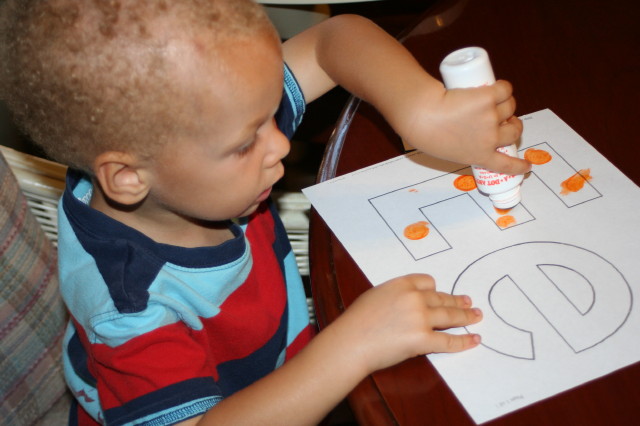
E is for…the short vowel e sound.  For phonics review (and phonics introduction for William!) and for our word box, we focused on the short vowel e sound.  We did some Explode the Code, added some short e words to our word boxes, and made words with play-doh. 

E is for…earnings.  We started Dave Ramsey’s Financial Peace Jr. University this week.  Joseph listened to Junior’s first adventure and we talked about earning commission.  Unfortunately Joseph was more enamored with the idea of doing wrong and being fined, so we shelved the commission chart for now.  We’ll revisit a little later.

 E is for…envelopes.  Joseph practiced writing letters and addressing envelopes this week.  He chose to write a letter to his friend Belle and to Grandpa Gary.  Both were pleased to receive his letter.

E is for…electricity.  I had great plans to read Switch On, Switch Off and The Magic School Bus and the Electric Field Trip, but we never got around to it.  We have a few weeks later on that don’t have a science theme, so we’ll fill in those weeks with these plans.   

E is for…Albert Einstein.  We read The Odd Boy Out, which Joseph and William had absolutely no interest in.  In hindsight Amelia Earhart probably would have been a better choice here.  On the positive side, I did learn a new tidbit of information that I was able to share with Daxson.  Did you know that the man who performed Einstein’s autopsy put Einstein’s brain in a jar and traveled across the United States with it?  He even wrote a book about it called Driving Mr. Albert: A Trip Across the United States with Einstein’s Brain.

E is for…eat nicely.  We’re still using these great coloring pages and we’re including one each week along with a virtue story. 

In our book baskets this week (I’m choosing one book from each basket to have Joseph do a narration and illustration of):

History (Albert Einstein): Odd Boy Out  

Science (electricity): Switch On, Switch Off; The Magic School Bus and the Electric Field Trip

Favorite E Books:  Every Friday; Emily’s First 100 Days of School; Even Firefighters Go to the Potty; Every Autumn Comes the Bear; Each Peach Pear Plum

D is for…

D is for…Daisy fairy, St. Dominic, and King David.  After reading Serendipity’s Flower Fairy story, Joseph and William colored pictures of the Daisy fairy.  Joseph also did some copywork from the poem that is in the Flower Fairy book (which he did while listening to the Flower Fairy CD).  Then we looked up the actual wildflower in our field guide.  We read about Saint Dominic in our Alphabet of Catholic Saints.  Joseph did some copywork.  We also used the picture from the book to practice the letter D formation.  We read about King David in Letters from Heaven, which naturally lead into telling the story of David and Goliath, which we did through The Children’s Book of Heroes and Tomie dePaola’s Bible Stories.  We used our dinosaurs to act out the story. 

D is for…the letter D.  We practiced letter formation using the Cuisenaire Rods Alphabet Book, Do A Dot, Salt Dough letters, and Pin Punch letters. 

D is for…dinosaurs.  We read about them, played with them, made pictures of them, and used their feet to make fossils in playdough.  How delightful! 


D is for…Davy Crockett.   We learned about Davy Crockett in A Picture Book of Davy Crockett and then Joseph wore his own version of a ‘coon hat.

D is for…desert life.  We watched Reading Rainbow: Desert Life and then Joseph did a drawing narrative about life in the desert.

D is for…doctor and dentist.  We read lots about doctors and dentists and germs and bacteria in books like Germs are Not for Sharing, Keeping Clean, Take Care of Your Teeth, Just Going to the Dentist and Usborne’s books Going to the Dentist and Going to the Doctor.  My sister passed on a great idea where the kids got to “clean” a plaque covered tooth.  I simply drew a tooth on a yellow piece of paper and they used white paint to clean the teeth.  We also got to practice our germ etiquette since everyone caught a cold…you can see William practicing coughing into his arm. 

D is for…duty.  We’re still using these great coloring pages and we’re including one each week along with a virtue story.  We also read about doing our duty in God’s Alphabet.

In our book baskets this week (I’m choosing one book from each basket to have Joseph do a narration and illustration of):

History (Davy Crockett): A Picture Book of Davy Crockett

Science (dinosaurs): Digging up Dinosaurs; Archaeologists Dig for Clues; The Magic School Bus in the Time of the Dinosaurs; The Dinosaur; First Picture Dinosaurs; Dinosaurs A to Z; Usborne First Encyclopedia of Dinosaurs and Prehistoric Life

Favorite D Books:  The Duchess Bakes a Cake; The Dog who Loved Red; The Deer in the Wood; The Doorbell Rang; Does a Kangaroo Have a Mother, Too?;  Duck for President

C is for…

C is for…Columbine fairy and St. Cecelia.  After reading Serendipity’s Flower Fairy story, Joseph and William colored pictures of the Columbine fairy.  Joseph also did some copywork from the poem that is in the Flower Fairy book (which he did while listening to the Flower Fairy CD).  Then we looked up the actual wildflower in our field guide.  We read about Saint Cecelia in our Alphabet of Catholic Saints.  Joseph did some copywork and both boys colored a picture of Saint Cecelia.  We also used the picture from the book to practice the letter C formation.  We read about cherubims in Letters from Heaven

C is for…the letter C.  We practiced letter formation using the Cuisenaire Rods Alphabet Book, Do A Dot, Salt Dough letters, and Pin Punch letters. 

C is for…Castles.  We read about life in a castle and then used our wooden castle to act out the story.

C is for…The Constitution.  We used Betsy Maestro’s book A More Perfect Union to learn the history of the Constitution.  We’ve added the Preamble to our morning routine, right after we say the Pledge of Allegiance.  We also watched The Preamble on Schoolhouse Rock (the song is so catchy that we usually end up singing the Preamble rather than reciting it!). 

C is for…St. Christopher.  We read Tomie dePaola’s book Christopher: The Holy Giant, after which Joseph did a narration and illustration. 

C is for…colors.  We had lots of fun with colors!  We did some color clothespin matching and some color mixing

C is for…creeks. After reading Box Turtle at Long Pond, we visited a nearby creek and saw lots of turtles. 

C is for…cat.  We studied Joseph Interpreting the Dreams of His Fellow Prisoners and then did a narration and illustration.

C is for…compassion and cookies.  I found these great coloring pages and we’re including one each week along with a virtue story.  This week the theme was Compassion.  To supplement our virtue studies, we read the book Cookies: Bite Size Life Lessons …one of my absolute favorites (and the kids’ too!) 

C is for…candles and cake.  We baked a cake in honor of Auntie Leslie’s birthday and then even blew out candles. 

C is for…Connect Four and chase!

In our book baskets this week (I’m choosing one book from each basket to have Joseph do a narration and illustration of):

History (The Constitution): A More Perfect UnionIf You Were There When They Signed the Constitution 

Science (creeks): Box Turtle at Long Pond; Follow the Water from Brook to Ocean

Favorite C Books:  Chicka Chicka Boom Boom; Chicka Chicka 123; The Carrot Seed; Cowboy’s Secret Life; Curious George books; Clifford books; Chrysanthemum; Corduroy; Charlie Needs a Cloak; A Child’s Rule of Life

B is for…

B is for…Bugle.  After reading Serendipity’s Flower Fairy story, Joseph and William colored pictures of the Bugle fairy.  Joseph also did some copywork from the poem that is in the Flower Fairy book (which he did while listening to the Flower Fairy CD).  Next week I plan to add some science study to this by looking up the actual wildflower. 

B is for…Saint Bernadette.  We read about Saint Bernadette in our Alphabet of Catholic Saints.  Joseph did some copywork and both boys colored a picture of Saint Bernadette.  We also used the picture from the book to practice the letter B formation.  While coloring, we listened to and prayed the Joyful Mysteries using this CD.  We read about St. Brendan in Letters from Heaven.  This was the perfect opportunity to learn about The Beatitudes and a perfect time to listen to David Haas sing Blest Are They (over and over and over)…I’m still singing it to myself.  B is also for the Tower of Babel, which we covered with a felt story.

B is for…the letter B.  We practiced letter formation using the Cuisenaire Rods Alphabet Book, Do A Dot, Salt Dough letters, and Pin Punch letters.  Our pin punches finally arrived this week and Joseph and William enjoyed learning to use them (William with lots of help from me; Joseph did beautifully all on his own). 


B is for…balls of all kind…big balls, little balls, bouncing balls and Birdie balls.

B is for… .  I found these great coloring pages and we’re including one each week along with a virtue story.  This week the theme was Blessings, which we talked about here and in God’s Alphabet

B is for…boats. We studied Thomas Eakins’ painting The Champion Single Sculls.  Joseph did a narration and both boys then copied the painting.


B is for…Bolivia, Belarus, Brazil and many more…We used blank outline maps again, a globe and our wall maps to locate states and countries that begin with the letter of the week. 

B is for…bread and blueberry pie.  We made four loaves of our favorite bread this week.  It just so happened to be Fr. “B”ill’s “b”irthday, as well, so we delivered a loaf of fresh bread to him.  While Grandma Cindy was in town, we baked a fresh blueberry pie (with some cranberries to fill it up). 

B is for…stringing beads, sorting buttons, and stacking blocks…and since we built with blocks, it was exciting to see some real building happening.

B is for…balancing with Ben.  Here are Joseph and William walking along the edge of the playground, balancing very carefully with their friends Ben, Gabe, and Walker. 

B is for…butterflies (and ball…yes, the ball went with us) at the Botanical Gardens.

B is for…the beach. 

B is for…brother…little brother Andrew, that is.  Andrew is proving to be a very attentive little brother, watching everything Joseph and William do…even school.

B is for…Belle, Joseph’s favorite friend.  We saw her at the end of A week (so technically the beginning of B week), but Joseph kept reminding me all during B week that B is for Belle and asking if we could please go see her…B week ran out before we got together, but here are some pictures from their last playdate (along with William, Andrew and Joe, of course!)

In our book baskets this week (I’m choosing one book from each basket to have Joseph do a narration and illustration of):

History (Benjamin Franklin): A Picture Book of Benjamin Franklin; How Ben Franklin Stole the Lightening; Rookie Biography

Science (birds): The Bird Alphabet Book; Make Way for Ducklings; Baby Birds and What They Eat; Owl Babies; Song of the Swallows; The Days of the Blackbird.  We also used Reading Rainbow’s DVD: Birds of a Feather

Favorite B Books:  Brown Bear, Brown Bear; Baby Farm Animals; The Bee Tree; The Big Green Pocketbook; Bearymore; Babushka’s Doll; Bad Case of Stripes; Because I Love You; Ballot Box Battle; Before the Stars were Made; The Brave Cowboy; Beatrice’s Goat; The Biggest Bed in the World; Big Red Barn; Bedtime for Frances; Birthday for Frances

A is for…

A is for Alphabet Path, which is the beautiful curriculum we’re using this year.  Head on over to Serendipity to see the Alphabet Path and all its beauty.  The greatest thing about it is how adaptable it is and how endless the possibilities are.  It’s a whole lot of fun thinking up ideas of what we can include (tonight at dinner, Joseph was “b”rainstorming ideas for week “B” and the list seemed to go on forever…bouncing balls, blowing bubbles, playing baseball…trust me, it’s easy and fun!) 

We’re using all of Serendipity’s plans, adapting the reading lists to the books that we have in our home library.  I’ve also added a few extras like a history block (just introducing some of America’s historical figures and moments), word box work (which is a basic introduction to alphabetizing and will provide fuel later for word sorting), physical education activites, and practical life activities.  William is traveling the Alphabet Path with us, with adaptations made that fit his age and learning style.   Joseph is also doing RightStart Math and The Ordinary Parent’s Guide to Teaching Reading (along with Explode the Code and Building Thinking Skills) in addition to his Alphabet Path work. 

Here are some highights from our A week activities (these really are just the highlights…this curriculum is so full of opportunities and rabbit trails that we actually took 2 weeks to complete our A activities!)…

A is for…apple aprons.  Auntie Leslie and Alex (and Uncle Dustin, who unfortunately doesn’t have an A anywhere in his name) were visiting on our first day of A week, so we made apple print aprons together.

A is for…Apple Blossom.  After reading Serendipity’s Flower Fairy story, Joseph and William colored pictures of the Apple Blossom fairy.  Joseph also did some copywork from the poem that is in the Flower Fairy book (which he did while listening to the Flower Fairy CD).  We also studied apple blossoms for science using Betsy Maestro’s book  How Do Apples Grow? which naturally read to a reading of one of our favorite books, Apple Picking Time

A is for…Saint Anne and angels.  We read about Saint Anne in our Alphabet of Catholic Saints.  Joseph did some copywork and both boys colored a picture of Saint Anne.  We also used the picture from the book to practice the letter A formation.  We read about angels in Letters from Heaven.  We’re using Letters from Heaven as a springboard for some Bible work this year.  There is a poem for each letter followed by a Bible verse reference.  I’m using that reference to teach Joseph how to use an actual Bible.  We’re also using the beautiful book God’s Alphabet for copywork.  Just so happens that A in both books refers to angels.   Later in the week we read Angels, Angels Everywhere and Joseph illustrated his favorite angel from the story.

A is for…the letter A.  Each week we’re taking advantage of the opportunity to practice correct letter formation using some various ideas such as Cuisenaire Rods Alphabet Book, Do A Dot, Salt Dough letters, and Pin Punch letters (although I’m still waiting for the pin punches to arrive…they’re on backorder). 


A is for…Adam and Eve.  I used the book Adam and Eve and the Garden of Eden to introduce the story of Adam and Eve.  Then we used our Betty Luken’s Bible Felt Set to re-enact the story.  Joseph and William then made apple tree fingerprint trees and Joseph did a narration of the book. 

A is for…Always Ask.  I found these great coloring pages and we’re including one each week along with a virtue story.  After talking about what it means to “Always Ask” we talked about the importance of also using the word please when we ask, which sent us hopping down the rabbit trail to re-read the story “Please” from The Children’s Book of Virtues and to dig out our manners book, Please Say Please!  Here are some pictures of Joseph asking to please borrow some crayons from William (“May I borrow your crayon please please?”) 

A is for…apples.  We studied Paul Cezanne’s Apples.  Joseph did a narration and then they both did a sketch. 

A is for…Alaska, Argentina, Austria, and many more…For geography, we’re using blank outline maps, a globe and our wall maps to locate states and countries that begin with the letter of the week.  If our pin punches ever arrive, we’ll add pin punching the country outlines to our activities. 

In our book baskets this week (I’m choosing one book from each basket to have Joseph do a narration and illustration of):

History (Johnny Appleseed and Abraham Lincoln):  The Story of Johnny Appleseed, Johnny Appleseed, Abe Lincoln: The Boy Who Loved Books, Abe Lincoln Remembers, Rookie Biography of Abraham Lincoln

Science (apples):  Apple Picking Time, How Do Apples Grow?, How to Make an Apple Pie and See the World

Favorite A Books: Dr. Seuss’s ABC, ABC Animal Jamboree, Adele and Simon, Amelia Bedelia series, Alexander and the Wind Up Mouse, The ABC Buny, The Alphabet Room, At the Beach, Apollo, Ask Mr. Bear

Finally, another fun A activity we did was an All About Me lapbook.  Joseph had a blast filling in all the details about himself. 

Now that you see how fun and easy it is, won’t you join us as we wander down the Alphabet Path this year?

Good Friday

I am at home today.  I am not at Church.  I am not participating in the Good Friday solemn liturgy or the Stations of the Cross.  I am home.  I am tending to two little energetic boys while trying to keep my feet up and the pressure off of my sciatic nerve.  I am sad that I cannot be there but I am grateful just that I am here.  Here.  Here.  Here.  I am here because Jesus died for me and for my sins.  Not only am I here, but hopefully someday I will be there.  There.  There.  There.  In the Kingdom of Heaven and all because of the sacrifice that God’s only Son made for me.  For my sins.  How can I possibly let this day pass without showing how incredibly grateful I am?  How can I possibly not spend this day sharing tradition and faith with my precious little ones so that they, too, become aware of the awesome sacrifice that Jesus made for us?  I can’t.  And so we are carrying on the best way we can in our little domestic church, listening to the Divine Mercy Chaplet (over and over again), praying the Stations in our own way, reenacting the events of Holy Week with felt, all while reflecting on the power of love and sacrifice, hoping that in these little acts, we are showing Jesus how incredibly grateful we truly are.

Ice Excavation

We live in a city where the majority of the year it’s sunny and warm.  Warm might be a little bit of an understatement.  It’s usually hot.  And humid.  We hardly ever have cold days and it’s a very rare event for the temperatures to actually drop below freezing.  This week we were in for a treat.  It got cold.  Very, very cold for us.  The temperatures dropped below freezing for a few nights and we even had a day where the temperature hovered right around 31.  Oooh, so very cold. 

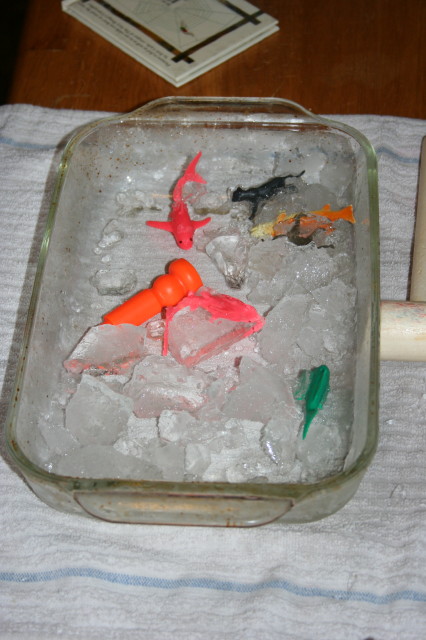
I wanted Joseph and William to get an idea of how cold it really was getting at night since we were all cuddled up under our down comforter, snug in our long sleeve pajamas.  So last night we filled a Pyrex pan with water and added a few sea creatures and then set it outside overnight to see what would happen.  This morning Joseph was amazed to see that the entire thing was frozen!  We brought it inside and I gave each of the boys a tool to begin excavating.  The chiseling and banging began and slowly, slowly, we were able to free our sea creatures.

Preschool: Religion and Fine Arts

(This is Part 3 in my Preschool Series.  Click here for Part 1: Language Arts or here for Part 2: Math and Science).

I want to start out by addressing the issue of me being a Catholic parent who uses Sonlight.  I truly believe that as homeschoolers and as parents, we are called to fill our homes and the eager little minds of our children with all things that are good, beautiful, and true.  That does not mean that Protestant or secular materials cannot be those things; nor does it mean that all things labeled Catholic are those things.  We must be wise consumers when it comes to choosing materials.  After much research, I felt that Sonlight’s early programs (I cannot speak on behalf of their programs for older elementary and up) were simply filled with rich literature and Christian based activities.  I have found that it is easy to substitute Catholic materials for some of their reading recommendations as well as any Bible lessons that I feel need supplementing or replacing.  It really has not been an issue with this early of an age.  There is also an excellent Yahoo! group called SL Catholic that is worth joining if you’re considering using Sonlight but want to make appropriate Catholic substitutions.

With that in mind, I’ll now address Religion.  Sonlight’s Pre-K 4/5 program does have a Bible section, which we sort of use.  I love the idea of a Bible verse each week (but I do look up each verse in my New American Bible), so we use that.  I introduce the Bible Verse on Monday morning and we continue to practice that particular verse first thing each morning.  We also practice our previous weeks’ Bible verses.  I hope to infuse these boys with God’s word so that it becomes common practice to have those words dancing around in their heads.  

We’re using the Family Time Bible in Pictures from Sonlight’s 4/5 program as well.  I like the simplicity of each story and I haven’t found a “Catholic” version quite like it yet (but I’m open to suggestions if you know of one!).  I’ve found a Catholic Bible for younger kids that I like as well as one for a little bit older children with longer stories, but I just haven’t stumbled across a Catholic Edition with the same length of stories as this particular bible.  We read a Bible story each day Tuesday through Thursday and use any appropriate felt board stories or other hands-on tools that we have (we have a great set of figurines that we use often to act out stories). 

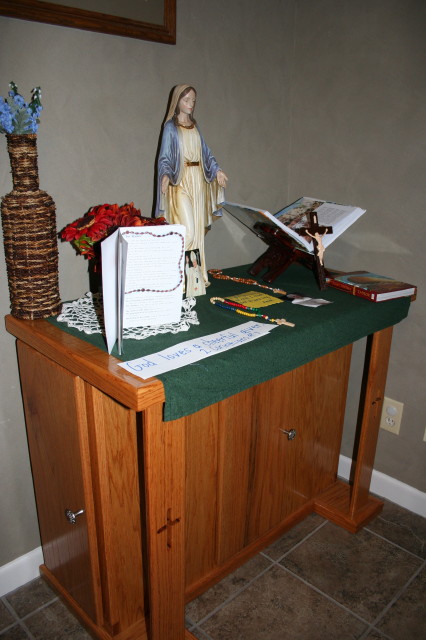
After our Bible verse and story, we spend some time at our prayer altar.  Joseph has a few particular prayers that he likes to pray daily, such as his Jesus prayer (Dear Jesus, I offer you today, all that I think and do and say) and the Memorare.  Then we let the Holy Spirit guide us.  Sometimes we say some more prayers.  Sometimes we read a story about a saint.  Sometimes we choose a book about God.  I lightly use Catholic Mosaic (when I say lightly it’s only because Joseph isn’t quite old enough to really use the program as intended, but it is a beautiful program that I intend to use throughout our schooling years…if you don’t have a copy, I’d highly recommend it) to guide us through the Liturgical year.  Since our prayer altar was custom built (thank you Grandpa Gary), it has an entire cabinet beneath the table that holds all of our religious books and many of those books are Catholic Mosaic choices.  While it may be a bit costly, I highly encourage you to consider purchasing (instead of simply borrowing from the library) many of the Catholic Mosaic books.  They are books your family will read time and time again, year after year. 

Just a little side note about including even the littlest ones in our religion lessons:  William always joins us during our prayer time.  No exceptions.  If, however, he is not interested in the day’s lesson, he’s always happy to browse through the shelves of books or play with our figurines while Joseph and I follow our lesson.  I find it remarkable that somehow both children understand that our prayer time is a special time in which to pray and learn about God.  They know to use quiet voices and to show respect for our prayer area. 

Our prayer altar actually holds a double purpose.  It is also our home atrium.  Do you know about the Catechesis of the Good Shepherd?  I’m not brave enough to try to summarize the theory behind it so I encourage you to either contact your local parish to see if it is offered near you so you can visit an actual atrium or to take some time to browse the Catechesis of the Good Shepherd’s website. There are also many excellent books written about the subject such as The Religious Potential of the Child and The Good Shepherd and the Child.  I was first introduced to an atrium when I taught at a local Catholic school.  It was, by far, the absolute most beautiful, peaceful, and effective method I had ever seen employed to teach children about Jesus.  Not only does the atrium teach necessary catechetical information, but more importantly it helps the children develop a real relationship with Jesus.  As a guide, I use Moira Farrell’s Home Cathechesis Manual.  It’s very well done.  We also have the Mass Kit and the Baptism Kit, which are available from Our Father’s House.        

For fine arts, we’re using a few little treasures.  Joseph’s learning the piano this year, with the help of Beethoven Bear and Mozart Mouse through a program called Music for Little Mozarts.  We’re still in the beginning of this program (book 1) so I cannot tell you how effective it is (yet) but I can tell you that Joseph finds it very exciting and if nothing else, it certainly has sparked in him an interest for learning to play the piano.  For music appreciation, we’re using Making Music, Praying Twice.  It’s kind of a Catholic version of Kindermusic and while it was a little pricey, I definitely think it’s worth the investment because it’s a music appreciation course that can be used from birth to age 8.  We’re having a great time.  The music CDs are so well done…they’re now our top pick for listening to in our free time!  We’re doing six weeks of music, followed by six weeks of art.  For Art, we’re using ARTistic Pursuits for Preschool.  What a gem!  For art appreciation, we’re alternating between Art Memo (a memory game with famous paintings…such a simple way to introduce the masters) and Mommy, it’s a Renoir.  And for art projects on rainy days, I use First Art by Mary Ann Kohl.  This book allows even William to participate without having to make any adaptations for his age. 

We’re still doing the same thing we did last year with regards to languages.  Grandma Nury comes once a week to work on Spanish.  They play games, draw pictures, have conversations.  It’s really quite beautiful.  (Yesterday, he was excited to discover that our friend Ingrid can speak Spanish, too!)  We’re still doing one lesson a week from Prima Latina, although obviously we’re not using the workbooks.  We just simply introduce the words and put them on flashcards, which we then practice from time to time during breakfast.  We’re just building a simple Latin vocabulary.  To keep ourselves from getting confused between languages, we use a simple method for our flashcards.  All Spanish flashcards are outlined in purple.  Latin are outlined in red.  Simple but effective.

Preschool: Math and Science

This is part 2 in my preschool series.  For Part 1: Language Arts and Social Studies, click here

Math is such fun at this early stage because it’s all hands-on.  Everything.  I don’t do a formal “math lesson” everyday simply because the manipluatives are such fun that we are easily able to amuse ourselves just by “playing.”   We have a few manipulatives that we consistently use like pattern blocks (sometimes with pattern cards and sometimes just with our own imaginations), Cuisenaire rods, geoboards, and snap cubes, but our shelves are full of other great math manipulatives (like a balance, Mighty Mind, an abacus, measuring tools, geometric solids, tangrams…).  Joseph (and William now, too) visibly lights up anytime a math manipulative is pulled out.  Both boys are happy to spend lots of time just exploring with the different manipulatives.  In my opinion, there are a lot of Montessori math manipulatives that are definitely worth adding to your shelf, provided it’s in your budget (or you are extremely handy and able to make them on your own). 

For a formal math program (for Joseph), we’re continuing with Saxon Math K, which is a huge hit.  Joseph loves the manipulatives and I love the brevity of each lesson.  I think we’ll finish with this before the year ends, but I’m not sure what we’ll move onto next.  I don’t think we’ll attempt Saxon Math 1 quite yet, since Joseph’s motor skills are not up to a 1st grade level.  I like the idea of Right Start Math and am more intrigued each time I look at the catalog.  Maybe in the spring, you’ll find us counting the “math way”…2 ten 1, 2 ten 2, and so on.  I also like Cuisenaire Rods, alot, and so I am intrigued by Miquon Math, as well.  I would love to hear your comments about what math programs you use (and/or have used).   

For science, I am using the plans included in Sonlight’s 4/5 program.  My only supplementation is nature study, so we’re exploring whatever bit of nature we find ourselves in (be it the backyard, the Botanical Gardens, the beach, etc).  Something new we’re trying this Fall is Five in a Row’s Nature Study guide.  You purchase each season separately, so we’re trying it for the fall and we’ll see how it goes.  Sometimes I also get a few ideas from the book Hug a Tree.  We take lots of nature walks and we’re always on the look-out for bits of nature to bring home and study.  Joseph’s not yet interested in keeping a nature notebook, but as soon as he shows an interest in drawing what he sees, we’ll add that to our agenda.

Preschool: Language Arts and Social Studies

I sat down and started this blog with the simple intention of just sharing with you the curriculum we’re using this year.  But you know me.  Once I get going, I just can’t stop.  I have to share every little detail!  So, I’m splitting this up into 4 parts: Language Arts and Social Studies; Math and Science; Religion and Fine Arts; Our Schedule and Organization.  So here’s Part 1.  Check back later for the other parts!

We decided to use Sonlight’s Pre-K 4/5 program for our foundation this year.  We used Sonlight’s Pre-K 3/4 program over the summer and absolutely loved it (a little side note in case you’re wondering why I chose Sonlight’s program in the first place…it’s really quite simple…I fell in love with their book selections…yep, it was that simple.  I read tons of catalogs and in the end, I decided that the best use of our money for preschool was to fill our home with good, quality literature and with Sonlight’s program, that’s where the majority of the money is going…toward books)!  Sonlight’s 3/4 program was filled with delightful and beautiful stories.  Everyday we anxiously opened our curriculum guide to see what was in store for us.  With such a raving success, I figured their Pre-K 4/5 program was the way to go. 

I like the way Sonlight has set up their curriculum guides with a checklist for each day of the week (the 3/4 program is not set up in the same way…rather that curriculum guide is set up by trimester with a list of stories to read and activities to do each trimester).  I like having a “basics” checklist…something that I can rely on in case I have no energy to plan or no time to supplement. 

I’m glad I chose Sonlight, but I have to admit I’m a little disappointed in a few aspects of this year’s program.  Little aspects.  Nothing big.  Nothing to make me change my mind.  Just a few little aspects that I feel call for supplementing.  First of all, the majority of the books in 4/5 are “storybooks.”  Each book is filled with lots of stories; each story is a few pages long with very few illustrations.  I think preschoolers thrive on picture books…it fuels their imaginations.  I agree with the idea that a good book should be able to stand alone by its words, but at this early of an age, a picture is worth so many words and especially for the little ones who are not reading yet, pictures make it possible for them to “read” the story.  Also, Joseph doesn’t seem too fond of the Uncle Wiggly Storybook.  He listens politely, but he just isn’t very excited when I pull Uncle Wiggly out.  We’ll try again in the Spring (and maybe later this fall we’ll use Jim Weiss’ audio version to spark some interest), but for now I simply added a little something to tweak the program to our interests.  My tweaking choices, you ask?  In addition to Sonlight’s Pre-K 4/5 program, we’re also using (again) Before Five in a Row and Peak with Books (we alternate those two programs depending on what we’re doing with Sonlight and what makes the best fit for our week…I’m trying to keep with Sonlight’s theme for the year of Exploring God’s World which is pretty easy to do considering how many different book options are covered between my two alternate programs).  In a few months I’ll probably add Five in a Row: Volume 1 (mainly because I like the geography tie-in and we’ve just about exhausted our Before Five in a Row booklist!) or I may add some books from Janet’s Sonlight Pre-K schedule, found on her Yahoo! Group SLPreschool (she’s done an awesome job and I highly recommend you join the group for access to her amazing schedule and recommendations).  That’s our foundation…basically, lots and lots of reading. 

For language arts, I started the year with Sonlight’s K Language Arts, but quickly realized the downfall of an organized, packaged language arts kit.  They assume that a child’s motor skills are on par with their reading skills.  I find this a bit curious, considering the fact that most kids don’t develop those two skills at the same rate.  The Kindergarten program is a well-put together program and I really like it…just not for Joseph.  He’s already reading, so it seems silly to spend an entire week just on the letter “f”.  We quickly abandoned it (although there are a few little gems we’re still using from it like Ruth Beechick’s Language and Thinking for Young Children, some of the copywork and some of the extension activities included in the curriculum guide).  Now we’re back to The Ordinary Parent’s Guide to Teaching Reading (yes, I know he can read, but to ensure there are no gaps, I think a phonics program is well worth the time…plus he enjoys it!).  We’re also using Handwriting without Tears, the Kindergarten edition.  We used their preschool program over the summer and he loved it.  Everything about it.  The singing, the movement, the wooden planks, the coloring, the writing.   For extra practice, we’re using Explode the Code’s workbooks.  We did start out with Explore the Code while we were using Sonlight LA K (and sometimes we still do a page or two just for fine motor skill practice) but now we’re in Book 1, which is a lovely place to be.  (Just a little note: I was torn between Explode the Code and MCP Phonics…in the end, I very scientifically made my choice by just closing my eyes and choosing, but honestly, I think both are excellent choices.)

Sonlight’s Pre-K 4/5 program does lightly cover Social Studies, but it’s very short and sweet.  I wanted something a little more so I’m supplementing with a wonderful little gem called Children Just Like Me.  We do a “child” a week which gives us a peek into other parts of the world (a perfect opportunity for some geography) and other cultures.  It fits in very well with Sonlight’s Pre-K 4/5 program, whose theme is “Exploring God’s World.”

I probably should have said this at the beginning: this list isn’t exhaustive but these are our main pieces…the curriculum pieces that are the core of our learning.  And these main pieces really do serve us well…the curriculum guides offer lots of beautiful suggestions and easy extensions (as well as recommended poetry, fingerplays, songs, etc).  In the end, after reading countless catalogs, we simply chose a curriculum and then tweaked it to fit our children’s needs.   That’s the true beauty of homeschooling…you can totally adapt things to fit just right.  So while it’s nice to read about what others are doing, don’t forget to listen to your own intuition in the end and choose what will work best for you and your little learners.